Čustveni kiborgi in izkušnja utelešenosti v hiperpovezani resničnosti
DOI:
https://doi.org/10.35469/poligrafi.2025.517Ključne besede:
čustveni kiborgi, teološki ekofeminizem, čustva, odnosnost, hiperpovezana resničnost, spolni stereotipiPovzetek
Skozi prizmo teološkega ekofeminizma članek kritično analizira koncept (čustvenih) kiborgov in postavlja vprašanje, kako lahko integracija tehnologije v človeške čustvene izkušnje spremeni posameznikove identitete, občutke in družbene odnose. Analizirana so vprašanja človeške interakcije z afektivnim računalništvom, umetno čustveno inteligenco (splošni izraz za stroje, ki posnemajo človeško mišljenje ter merijo, razumejo in simulirajo človeška čustva ter odgovarjajo na ta).
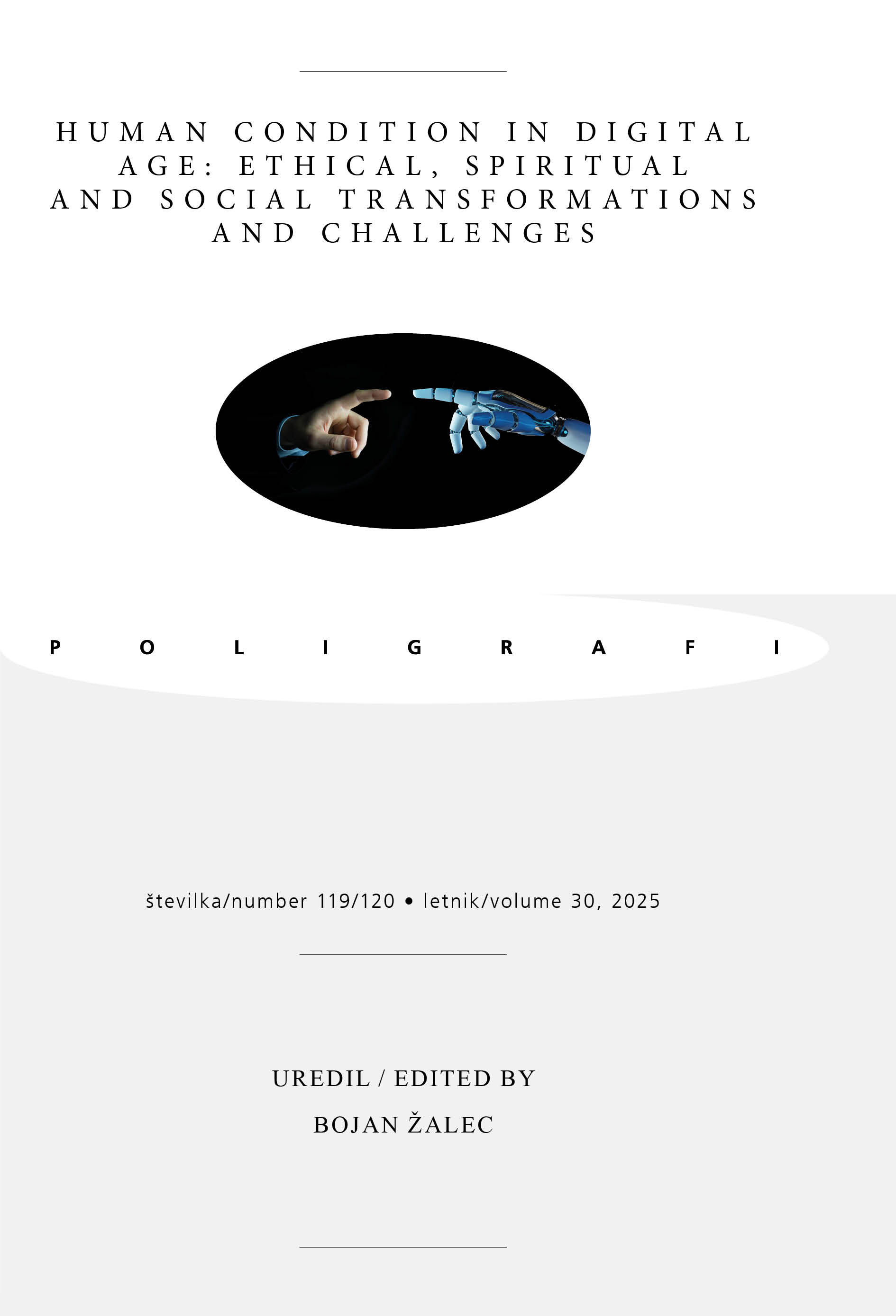
Z napredkom umetne inteligence in biotehnologije se meje med človekom in strojem vse bolj zamejujejo, pojem čustvenega kiborga pa postaja močen okvir za razumevanje razvijajočih se človeških čustev in odnosov.
Članek se navezuje na širše družbeno-kulturne teme, vključno s prizadevanjem za avtentičnost v hiperpovezanem svetu, kjer digitalne interakcije pogosto zasenčijo osebne odnose. Skozi prizmo posthumanizma in kritične ekofeministične teorije članek raziskuje izzive prepletenosti človeške in umetne čustvene inteligence, vključno z možnostjo posledične odtujenosti, upada čustvene inteligence in empatije ter tveganj komodifikacije človeških čustev.
Raziskuje tudi, kako ta premik vpliva na sodobna vprašanja, kot so duševno zdravje, družbena izolacija in gradnja skupnosti.
Predstavitev na koncu raziskuje presečišče čustvenih kiborgov in izkušenj odnosnosti v hiperpovezanih resničnostih ter razmišlja o tem, kako te entitete izzivajo in preoblikujejo tradicionalno teološko razumevanje spola, utelešenja in odnosnosti. Čustveni kiborg, združitev človeških čustvenih sposobnosti z umetno inteligenco, deluje kot ogledalo družbenih konstrukcij spola, utelešene čustvenosti in odnosov, hkrati pa na njih tudi vpliva.
Prenosi
Literatura
Danaher, John, and Neil McArthur (eds.). Robot Sex: Social and Ethical Implications. Cambridge, MA: MIT Press, 2017. (Ebook May 2018).
Delio, Ilia. Re-Enchanting the Earth: Why AI Needs Religion. New York: Orbis Books, 2019.
Haraway, Donna. Simians, Cyborgs and Women: The Reinvention of Nature. London: Routledge, 1990.
Hayles, Katherine. “Unfinished Work: From Cyborg to Cognisphere.” Theory, Culture & Society 23, no. 7–8 (2006): 159–166. https://doi.org/10.1177/0263276406069229.
Hayles, Nancy Katherine. How We Became Posthuman: Virtual Bodies in Cybernetics, Literature, and Informatics. Chicago & London: University of Chicago Press, 1999.
Herzfeld, Noreen. In Our Image: Artificial Intelligence and the Human Spirit. Minneapolis: Fortress Press, 2002.
Herzfeld, Noreen. “Creating in Our Own Image: Artificial Intelligence and the Image of God.” Zygon: Journal of Religion and Science 37, no. 2 (2002): 303–316. https://doi.org/10.1111/0591-2385.00430.
Herzfeld, Noreen. “In Whose Image? Artificial Intelligence and the Imago Dei.” In Blackwell Companion to Science and Christianity, edited by J. B. Stump and Alan Padgett, 500–509. Chichester: WileyBlackwell, 2012.
Herzfeld, Noreen. Religion and New Technologies. Basel: MDPI, 2017.
Herzfeld, Noreen L., and Robert H. Latiff. “Can Lethal Autonomous Weapons Be Just?” Peace Review, 33, no. 2 (2022): 213–219. https://doi.org/10.1080/10402659.2021.1998750.
Keller, Catherine. Face of the Deep: A Theology of Becoming. London: Routledge, 2002.
Keller, Catherine. God and Power: CounterApocalyptic Journeys. Minneapolis: Fortress Press, 2005.
Keller, Catherine. Intercarnations: Exercises in Theological Possibility. New York: Fordham University Press, 2017.
Keller, Catherine. No Matter What: Crisis and the Spirit of Planetary Possibility. New York: Fordham University Press, 2024.
Platovnjak, Ivan, and Tone Svetelj. “Artificial Intelligence and Imago Dei: A New Dilemma for Philosophical and Theological Anthropology.” Bogoslovni vestnik / Theological Quarterly 84, no. 4 (2024): 835-846. https://doi.org/10.34291/BV2024/04/Platovnjak.
Stiegler, Bernard. What Makes Life Worth Living: On Pharmacology. Cambridge, UK: Polity, 2013.
Stiegler, Bernard. “Relational Ecology and the Digital Pharmakon.” Culture Machine 13 (2012). Accessed May 30, 2025. https://culturemachine.net/wp-content/uploads/2019/01/464-1026-1-PB.pdf.
Turkle, Sherry. Alone Together: Why We Expect More from Technology and Less from Each Other. New York: Basic Books, 2012.
Vendramin, Valerija. “Umetnost pripovedovanja znanstvenih zgodb: Ob 35-letnici Kiborškega manifesta.” Alternator, no. 55 (2020). Accessed September 10, 2021. https://doi.org/10.3986/alternator.2020.55.
Vienna Manifesto on Digital Humanism. DIGHUM, Vienna, May 2019. Accessed June 10, 2025. https://dighum.ec.tuwien.ac.at/wp-content/uploads/2019/05/manifesto.pdf.
Zhang, Wanqing. “The AI Girlfriend Seducing China’s Lonely Men.” Sixth Tone, December 7, 2020. https://www.sixthtone.com/news/1006531.
Prenosi
Objavljeno
Kako citirati
Številka
Rubrike
Licenca
Avtorske pravice (c) 2025 Nadja Furlan Štante

To delo je licencirano pod Creative Commons Priznanje avtorstva 4.0 mednarodno licenco.
Open Access Policy and Copyright
This journal provides immediate open access to its content on the principle that making research freely available to the public supports a greater global exchange of knowledge. Users are allowed to read, download, copy, distribute, print, search, or link to the full texts of the articles, or use them for any other lawful purpose, without asking prior permission from the publisher or the author.
Authors who publish with this journal agree to the following terms:
- Authors retain copyright and grant the journal right of first publication with the work simultaneously licensed under the terms of the Creative Commons Attribution license (CC BY) that allows others to share the work with an acknowledgement of the work’s authorship and initial publication in this journal.
- Authors grant the publisher commercial rights to produce hardcopy volumes of the journal for sale to libraries and individuals.
- Authors are able to enter into separate, additional contractual arrangements for the non-exclusive distribution of the journal’s published version of the work (e.g., post it to an institutional repository or publish it in a book), with an acknowledgement of its initial publication in this journal.