Emotional Cyborgs in a Hyperconnected World: AI, Embodiment, and Ecofeminist, Theological Reflections on Humanity and the Divine
DOI:
https://doi.org/10.35469/poligrafi.2025.517Keywords:
emotional cyborgs, theological ecofeminism, emotions, relationality, hyperconnected reality, gender stereotypesAbstract
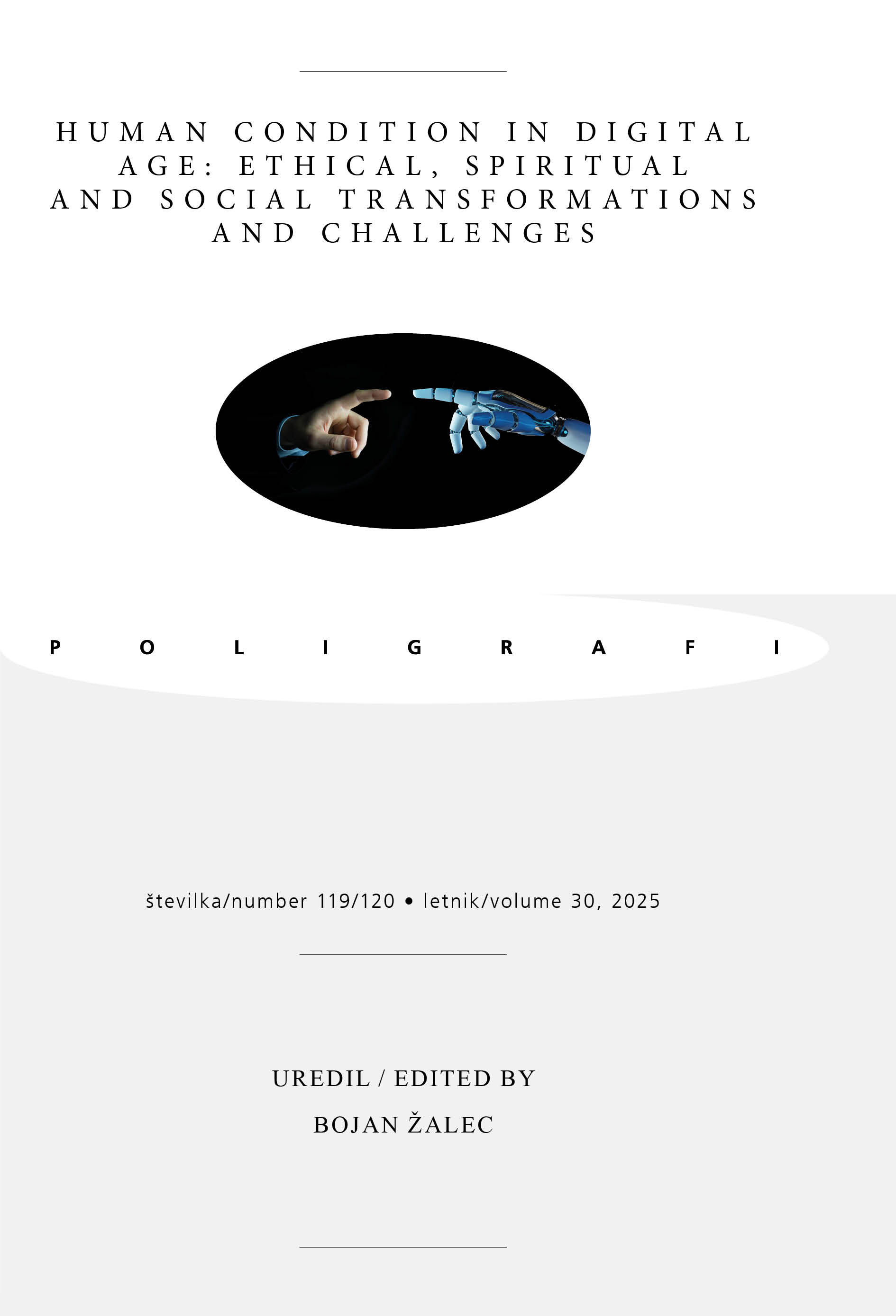
Through the critical lens of theological ecofeminism, this article offers a nuanced analysis of the concept of the (emotional) cyborg, interrogating how the integration of technology into human (emotional) life reshapes individual identity, affective experience, and social relationality. Central to this inquiry are the dynamics of human interaction with affective computing and artificial emotional intelligence, broadly defined as technological systems capable of mimicking, interpreting, simulating, and responding to human emotions.
As developments in artificial intelligence and biotechnology continue to advance, the boundary between human and machine becomes increasingly porous. Within this context, the figure of the emotional cyborg emerges as a compelling framework for examining the transformation of human emotion and connection in technologically mediated environments.
This investigation is situated within broader socio-cultural concerns, particularly the contemporary quest for authenticity in a hyperconnected world, where digital interactions frequently eclipse embodied, face-to-face communication. Drawing on posthumanist and critical ecofeminist theory, this article explores the implications of the entanglement between human and artificial emotional intelligence. Among the key concerns are the potential for emotional alienation, the erosion of empathy and emotional literacy, and the commodification of affective life.
In addition, the analysis engages with the implications of these shifts for pressing contemporary issues, including mental health, social isolation, and the reconfiguration of community and belonging. At its core, the presentation interrogates how emotional cyborgs intersect with gendered experiences within technologically saturated realities, and challenges and reimagines traditional theological conceptions of embodiment and relationality.
The emotional cyborg, conceived as the hybridization of human emotional capacities with artificial intelligence, functions simultaneously as a reflection of and intervention in prevailing social constructions of gender, affectivity, and intersubjective connection.
Downloads
References
Danaher, John, and Neil McArthur (eds.). Robot Sex: Social and Ethical Implications. Cambridge, MA: MIT Press, 2017. (Ebook May 2018).
Delio, Ilia. Re-Enchanting the Earth: Why AI Needs Religion. New York: Orbis Books, 2019.
Haraway, Donna. Simians, Cyborgs and Women: The Reinvention of Nature. London: Routledge, 1990.
Hayles, Katherine. “Unfinished Work: From Cyborg to Cognisphere.” Theory, Culture & Society 23, no. 7–8 (2006): 159–166. https://doi.org/10.1177/0263276406069229.
Hayles, Nancy Katherine. How We Became Posthuman: Virtual Bodies in Cybernetics, Literature, and Informatics. Chicago & London: University of Chicago Press, 1999.
Herzfeld, Noreen. In Our Image: Artificial Intelligence and the Human Spirit. Minneapolis: Fortress Press, 2002.
Herzfeld, Noreen. “Creating in Our Own Image: Artificial Intelligence and the Image of God.” Zygon: Journal of Religion and Science 37, no. 2 (2002): 303–316. https://doi.org/10.1111/0591-2385.00430.
Herzfeld, Noreen. “In Whose Image? Artificial Intelligence and the Imago Dei.” In Blackwell Companion to Science and Christianity, edited by J. B. Stump and Alan Padgett, 500–509. Chichester: WileyBlackwell, 2012.
Herzfeld, Noreen. Religion and New Technologies. Basel: MDPI, 2017.
Herzfeld, Noreen L., and Robert H. Latiff. “Can Lethal Autonomous Weapons Be Just?” Peace Review, 33, no. 2 (2022): 213–219. https://doi.org/10.1080/10402659.2021.1998750.
Keller, Catherine. Face of the Deep: A Theology of Becoming. London: Routledge, 2002.
Keller, Catherine. God and Power: CounterApocalyptic Journeys. Minneapolis: Fortress Press, 2005.
Keller, Catherine. Intercarnations: Exercises in Theological Possibility. New York: Fordham University Press, 2017.
Keller, Catherine. No Matter What: Crisis and the Spirit of Planetary Possibility. New York: Fordham University Press, 2024.
Platovnjak, Ivan, and Tone Svetelj. “Artificial Intelligence and Imago Dei: A New Dilemma for Philosophical and Theological Anthropology.” Bogoslovni vestnik / Theological Quarterly 84, no. 4 (2024): 835-846. https://doi.org/10.34291/BV2024/04/Platovnjak.
Stiegler, Bernard. What Makes Life Worth Living: On Pharmacology. Cambridge, UK: Polity, 2013.
Stiegler, Bernard. “Relational Ecology and the Digital Pharmakon.” Culture Machine 13 (2012). Accessed May 30, 2025. https://culturemachine.net/wp-content/uploads/2019/01/464-1026-1-PB.pdf.
Turkle, Sherry. Alone Together: Why We Expect More from Technology and Less from Each Other. New York: Basic Books, 2012.
Vendramin, Valerija. “Umetnost pripovedovanja znanstvenih zgodb: Ob 35-letnici Kiborškega manifesta.” Alternator, no. 55 (2020). Accessed September 10, 2021. https://doi.org/10.3986/alternator.2020.55.
Vienna Manifesto on Digital Humanism. DIGHUM, Vienna, May 2019. Accessed June 10, 2025. https://dighum.ec.tuwien.ac.at/wp-content/uploads/2019/05/manifesto.pdf.
Zhang, Wanqing. “The AI Girlfriend Seducing China’s Lonely Men.” Sixth Tone, December 7, 2020. https://www.sixthtone.com/news/1006531.
Downloads
Published
How to Cite
Issue
Section
License
Copyright (c) 2025 Nadja Furlan Štante

This work is licensed under a Creative Commons Attribution 4.0 International License.
Open Access Policy and Copyright
This journal provides immediate open access to its content on the principle that making research freely available to the public supports a greater global exchange of knowledge. Users are allowed to read, download, copy, distribute, print, search, or link to the full texts of the articles, or use them for any other lawful purpose, without asking prior permission from the publisher or the author.
Authors who publish with this journal agree to the following terms:
- Authors retain copyright and grant the journal right of first publication with the work simultaneously licensed under the terms of the Creative Commons Attribution license (CC BY) that allows others to share the work with an acknowledgement of the work’s authorship and initial publication in this journal.
- Authors grant the publisher commercial rights to produce hardcopy volumes of the journal for sale to libraries and individuals.
- Authors are able to enter into separate, additional contractual arrangements for the non-exclusive distribution of the journal’s published version of the work (e.g., post it to an institutional repository or publish it in a book), with an acknowledgement of its initial publication in this journal.