Experiencing Mortality and Transcendence in the Digital Age
DOI:
https://doi.org/10.35469/poligrafi.2025.507Keywords:
digital culture, mortality, transcendence, dataism, imago Dei, Yuval Harari, Hans JonasAbstract
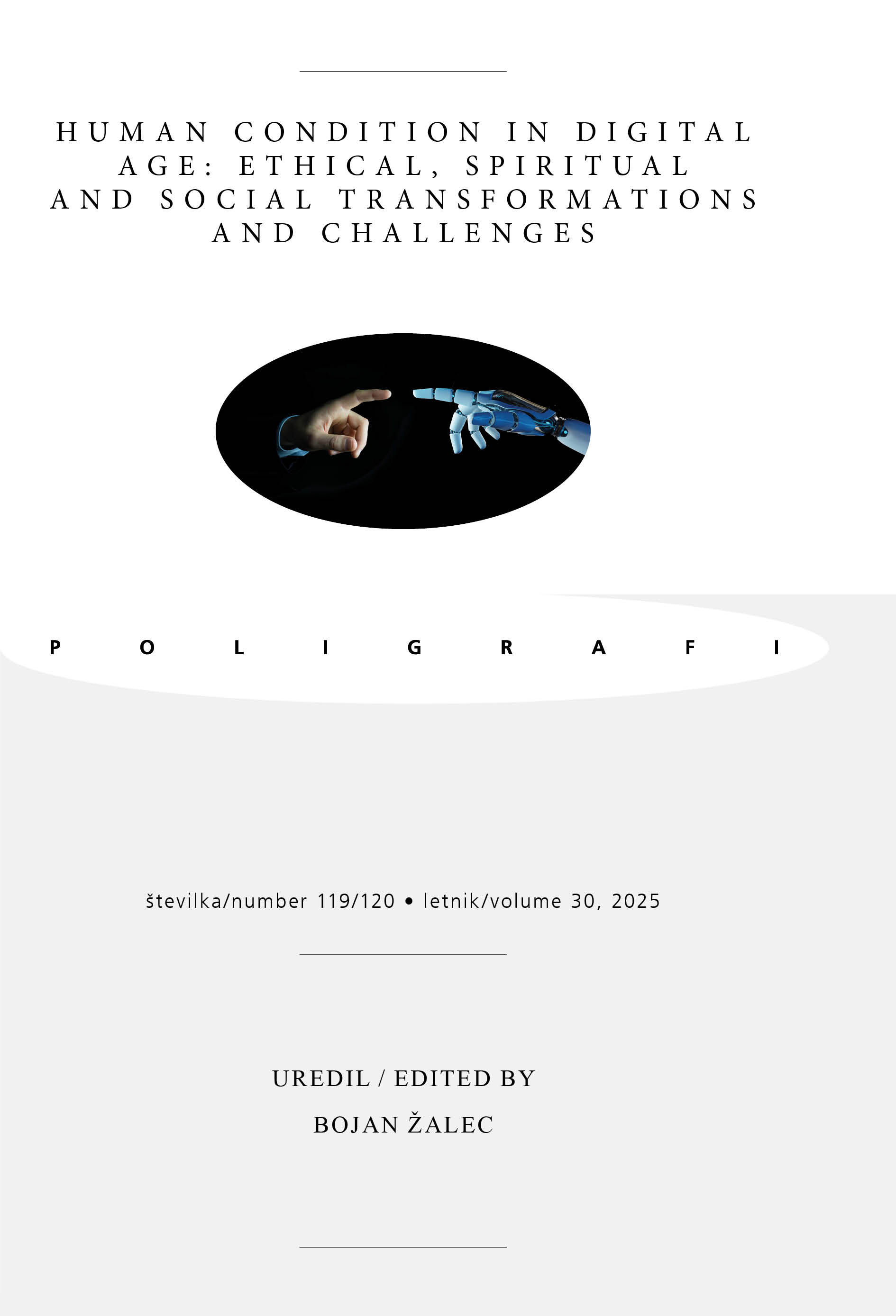
The rapid development of digital technology is also bringing changes to the experience of mortality and transcendence. New possibilities for prolonging life and the promise of immortality are prompting a reevaluation of who human beings truly are and what path of development they should take to preserve the possibility of living with dignity in the future. In the first part, I critically evaluate Yuval Harari’s provocative work Homo Deus, which suggests a transition from conditio humana to conditio posthumana, which is marked by desires for immortality, happiness, and divinity. He believes that algorithms play a central role in digital culture and are gaining increasing trust among people. A view called dataism is gaining prominence, which posits that all of reality is merely a collection of data. In the second part, I contrast this view with Hans Jonas’s philosophy of the organism, which sees the living organism as a paradigm of being. The living organism cannot be reduced to data, and therefore, the whole of reality transcends the data level. An essential part of a living being is its mortality, which Jonas understands as both a burden and a blessing: without death, there is no new life. The last section is devoted to theological reflection on the dual character of human life alongside the first three chapters of Genesis. The fundamental biblical truth is that humanity is created in the image of God, which means that they are created transient, vulnerable, and mortal, but at the same time transcended and called to eternity. The basic thesis of this paper is that mortality is part of that human being created in God’s image and that it is within our physicality and transience that we experience the longing to transcend this world and to seek eternity. Faith in a personal God, within the context of reductionist dataism, frees one from being trapped in the determinism of algorithms and gives one the courage to make responsible choices for the future of humanity.
Downloads
References
AI Research Group for the Center for Digital Culture of the Dicastery for Culture and Education of the Holy See. Encountering Artificial Intelligence: Ethical and Anthropological Investigations. Eugene: Pickwick Publications, 2024.
Appel, Kurt. “The Price of Prayer.” In In Praise of Mortality: Christianity and New Humanism, edited by Kurt Appel, 141–173. Paderborn: Brill Schöningh, 2022.
Arendt, Hannah. The Human Condition. Chicago: The University of Chicago Press, 1958.
Arnold, Bill T. Genesis. Cambridge: Cambridge University Press, 2009.
Aydin, Ciano, and Peter-Paul Verbeek. “Transcendence in Technology.” Techné: Research in Philosophy and Technology 19, no. 3 (2015): 291–313. https://doi.org/10.5840/techne2015121742.
Benanti, Paolo. Digital Age: Teoria del cambio d’epoca: Persona, famiglia e società. Cinisello Balsamo: San Paolo Edizioni, 2020.
Büsch, Andreas. “Das Geschöpf im Netz: Auf der Suche nach dem digitalem Selbst.” In Theologie und Digitalität: Ein Kompendium, edited by Wolfgang Beck, Ilona Nord, and Joachim Valentin, 200–215. Freiburg: Herder, 2021.
Farman, Abou. “Transhumanism.” The Open Encyclopedia of Anthropology, edited by Felix Stein. Published 8 September 2022. http://doi.org/10.29164/22transhumanism.
Harari, Yuval Noah. Homo Deus: a Brief History of Tomorrow. Toronto: Signal Books, 2016.
Jonas, Hans. “The Burden and Blessing of Mortality.” The Hastings Center Report 22, no. 1 (1992): 34–40.
Jonas, Hans. Organismus und Freiheit: Ansätze zu einer philosophischen Biologie. Göttingen: Vandenhoeck & Ruprecht, 1973.
Jonas, Hans. Philosophische Untersuchungen und metaphysische Vermutungen. Frankfurt am Main: Insel, 1992.
Jonas, Hans. The imperative of responsibility: in search of an ethics for the technological age. Chicago: The University of Chicago Press, 1984.
Jonas, Hans. The phenomenon of life: toward a philosophical biology. New York: Harper & Row, 1966.
Klun, Branko. “Problem religioznega izkustva v digitalno transformiranem svetu: eksistencialno fenomenološki pristop.” Bogoslovni vestnik 84, no. 1 (2024): 19–32. https://doi.org/10.34291/BV2024/01/Klun.
Kraner, David. “The Internet, the Problem of Socialising Young People, and the Role of Religious Education.” Religions 14, no. 4 (2023): 1–15. https://www.mdpi.com/2077-1444/14/4/523.
Kurzweil, Ray. The Singularity Is Nearer: When We Merge with AI. London: Penguin Books, 2024.
Matteo, Armando. La prima generazione incredula: il difficile rapporto tra i giovani e la fede. Soveria Mannelli: Rubbettino, 2017.
Platovnjak, Ivan, and Tone Svetelj. “Artificial Intelligence and Imago Dei: A New Dilemma for Philosophical and Theological Anthropology.” Bogoslovni vestnik 84, no. 4 (2024): 835−846. http://doi.org/10.34291/BV2024/04/Platovnjak.
Platovnjak, Ivan, and Tone Svetelj. “Technology as the Elixir of Immortality – Resurgent Philosophical and Spiritual Enigma of Human Imprisonment.” Bogoslovni vestnik 83, no. 4 (2023): 973–984. http://doi.org/10.34291/BV2023/04/Platovnjak.
Rahner, Karl. Foundations of Christian Faith: An Introduction to the Idea of Christianity. New York: The Crossroad Publishing Company, 1992.
Valentin, Joachim. “Versprechen der Digitalisierung und Verheißungen Gottes.” In Theologie und Digitalität: Ein Kompendium, edited by Wolfgang Beck, Ilona Nord, and Joachim Valentin, 347–367. Freiburg: Herder, 2021.
Westermann, Claus. Genesis 1–11. Minneapolis: Augsburg Publishing House, 1984.
Žalec, Bojan. Človečnost v digitalni dobi: izzivi umetne inteligence, transhumanizma in genetike. Ljubljana: Teološka fakulteta, 2023. https://www.teof.uni-lj.si/uploads/Zalozba/ZnK86-Zalec-clovecnost_elektronska.pdf.
Downloads
Published
How to Cite
Issue
Section
License
Copyright (c) 2025 Roman Globokar

This work is licensed under a Creative Commons Attribution 4.0 International License.
Open Access Policy and Copyright
This journal provides immediate open access to its content on the principle that making research freely available to the public supports a greater global exchange of knowledge. Users are allowed to read, download, copy, distribute, print, search, or link to the full texts of the articles, or use them for any other lawful purpose, without asking prior permission from the publisher or the author.
Authors who publish with this journal agree to the following terms:
- Authors retain copyright and grant the journal right of first publication with the work simultaneously licensed under the terms of the Creative Commons Attribution license (CC BY) that allows others to share the work with an acknowledgement of the work’s authorship and initial publication in this journal.
- Authors grant the publisher commercial rights to produce hardcopy volumes of the journal for sale to libraries and individuals.
- Authors are able to enter into separate, additional contractual arrangements for the non-exclusive distribution of the journal’s published version of the work (e.g., post it to an institutional repository or publish it in a book), with an acknowledgement of its initial publication in this journal.
- All articles are deposited in Digital repository of Slovenian research organizations (DiRROS) under a Creative Commons Attribution 4.0 International license (CC BY 4.0) and the digital department of Slovenian national library NUK, dLib.